- within Employment and HR and Technology topic(s)
- with readers working within the Securities & Investment industries
Damselfly Global LLC (Applicant) filed a U.S. intent to use application to register the mark shown below (disclaiming the exclusive right to use NY) for, among other things, back packs, clothing items, and plant seeds.

The Trademark Examining Attorney refused registration as to the goods (other than plant seeds) based on a likelihood of confusion with the iconic I NY marks registered by the New York State Department of Economic Development (Registrant):
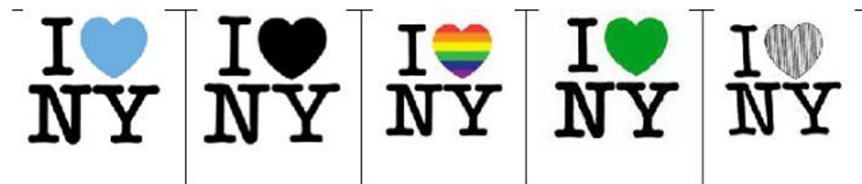
The mark actually used by Registrant is:

Applicant appealed to the Trademark Trial and Appeal Board (TTAB), which affirmed the refusal of registration. The TTAB focused on the registered mark with the black heart design element (without a claim to any color). That registration covered goods that overlapped the goods in issue in the application, and the respective goods were presumed to travel in the same channels of trade and to the same classes of consumers.
As to the strength of the registered mark, the TTAB found that mark commercially strong due to its use in an extremely popular and widespread marketing campaign, which Registrant acknowledged.
As to that mark's conceptual strength, Applicant submitted copies of twenty use-based registrations of marks containing an format, and Applicant argued that these registrations showed that the literal elements of the marks were relatively weak and should get less weight than the design elements. However, the TTAB pointed out that most of the submitted third-party registrations contained additional distinguishing elements referring to a location, object or even a verb. Only three referred to NY, but they used different symbols in place of the symbol, and one used the word "LOVE" inside the symbol. Nevertheless, the TTAB found that the frequent registration of marks containing the format showed that these sorts of affinity marks are somewhat weak conceptually.
In comparing the Applicant's and Registrant's marks, the TTAB acknowledged differences in Registrant's heart design versus Applicant's flower and vine design elements. It also acknowledged the respective marks used different fonts, although they were still fairly similar overall, especially to a consumer with a general recollection of the cited mark.
However, despite the fact that the word portion of a mark normally has more weight than a design portion, the TTAB found that they were equally prominent in these respective marks with neither the wording nor design element being dominant.
The TTAB was not sure how Applicant's mark would be pronounced. But given the fact that flowers are often associated with love, pronouncing Applicant's mark as "I LOVE NEW YORK" was at least as reasonable as pronouncing it as "I FLOWER NEW YORK" or "I ROSE NEW YORK." The TTAB also rejected Applicant's unsupported attempt to distinguish the connotation of its mark as meaning "flowers are wonderful, beautiful, and easy to enjoy."
In sum, the TTAB found that, given that the marks were presented with the same structure and used a design element to convey a message about affinity with New York, the flower could be seen as an extension of Registrant's message, or simply a variant of Registrant's mark.
Accordingly, the TTAB affirmed the likelihood of confusion refusal to register Applicant's mark for the goods in issue.
Although the TTAB allowed the application to proceed as to plant seeds, Registrant indicated its possible opposition, and Applicant expressly abandoned its application on April 17, 2025.
The content of this article is intended to provide a general guide to the subject matter. Specialist advice should be sought about your specific circumstances.